

Wharton Stories

Exploring a Wharton Education Without Limits

Image: Professor of Marketing Americus Reed engages EMBA and MBA students for his Block Week course, Sales 3.0 and the Future of Revenue Growth. (Image Credit: Jeremy Francis)
“Anybody can get on a plane and go somewhere, but we want the Wharton experience to be more multidimensional and more integrated with the rest of a student’s education.” — Cait Lamberton, vice dean and director of the Wharton Undergraduate Division

Whether analyzing consumer behavior in Philadelphia, walking factory floors in Stockholm, or debating revenue models alongside Wharton alumni abroad, exploratory learning exists at the heart of a Wharton education across programs and degrees. It is a chance for students to go beyond the conventional classroom setting and into real-world environments where business theory meets practice. These experiences, in turn, help students expand their thinking and test what they learn.

“Anybody can get on a plane and go somewhere,” says Cait Lamberton, vice dean and director of the Wharton Undergraduate Division. “But we want the Wharton experience to be more multidimensional and more integrated with the rest of a student’s education.”

At every level, Wharton’s scope of learning opportunities are designed to meet that vision — giving students the flexibility, global access, and practical education they need to navigate a rapidly changing world. Block Weeks and Global Modular Courses (GMCs) are particularly familiar to students in the full-time MBA and MBA Program for Executives (EMBA), although the Undergraduate Program similarly hosts a range of options to suit students’ busy schedules and unique needs.


Exploratory Learning for Wharton Undergraduates

Wharton offers exploratory options through its Undergraduate Program, combining concentrated study with travel and real-world application. These flexible opportunities provide students the freedom to explore industry practice, engage with Wharton’s global network, and build a sense of community with their peers.

“The truth is that many schools have travel classes,” notes Lamberton. “But, because Wharton has such an incredible alumni network, we often have connections at companies that are excited about partnering with us to create a more robust experience for our students.”

Beyond select GMCs open to Wharton undergraduates in their third and fourth years of study, undergraduates have plenty of other options:

The majority of these qualify as Wharton School-wide global immersion opportunities, offering rich, travel-based learning open to both undergraduate and graduate students.
 

Modular Courses at Wharton

Modular courses add another dimension to exploratory learning. These 3- or 4-day intensive experiences, worth 0.5 course units, offer flexibility and focus to students at various levels. Modular courses can fulfill credit requirements while customizing a student’s academic path and broadening global perspective.

Wharton offers two modular formats:

Global Modular Courses (GMCs), open to both undergraduate and graduate students

Block Weeks, exclusive to full-time MBA and EMBA students

According to Richard Paul Waterman, practice professor of statistics and data science and EMBA’s deputy vice dean for academic affairs, these approaches encourage invaluable interaction: “It’s a great platform for cross-pollination between Executive MBA and full-time MBA students. [Students] spend time together, collaborate, and learn from one another. That kind of interaction deepens the network you build at Wharton.”


Global Modular Courses (GMCs) Take Wharton Everywhere

GMCs bring students directly into the business realities of regions undergoing rapid change. Over 3-4 immersive days — typically scheduled during academic breaks — students blend faculty-led coursework with site visits, conversations with local leaders, interaction with Wharton alumni and students from host institutions, and exposure to emerging business and social issues.

“GMCs operate at the forefront of innovation in business education, exploring emerging business models, evolving mindsets, disruptions, and innovations,” explains Ziv Katalan, managing director for Wharton Global Initiatives. “They represent Wharton’s ‘laboratory’ for understanding the future of management education.”

During a GMC in the United Arab Emirates (UAE), Wharton undergraduate Fatima Figueroa, W’24, found herself examining how emerging economies take shape by hearing directly from leaders on the ground. “This course deeply enhanced my understanding,” she reflected. “I learned about emerging economies like the UAE and how they seize opportunities, attract talent, and differentiate themselves.” Experiences like this — combining local immersion, faculty expertise, and firsthand perspectives — illustrate exactly how GMCs turn theory into lived learning.

GMC participation at Wharton includes the following:

  • Open enrollment for EMBA, full-time MBA, and third- and fourth-year undergraduate students.
  • Completion of one or two courses on average, with some students taking up to five or six.
  • Two additional required GMCs for the EMBA Global cohort, which are optional for Philadelphia and San Francisco cohort students.
  • Courses offered in multiple countries each year, connecting students to live cases and local expertise to bring academic concepts into sharp focus.
  • A required Global Business Week (GBW) for second-year EMBA students.

Learn more about the GBW experience and additional options for international study, including the full scope of GMCs.


Block Weeks: Concentrated Learning for Busy Students

Block Weeks are immersive 3- to 4-day courses blending rigorous academic work with real-world relevance, and covering traditional business foundations for emerging trends. Designed exclusively for EMBA and full-time MBA students, they feature experiential learning, deeper cross-cohort collaboration, site visits, and guest speakers — all with flexible scheduling and opportunities to accelerate graduation. Wharton syncs EMBA and full-time MBA calendars for Block Weeks to focus on a total of four individual weeks peppered throughout the year.
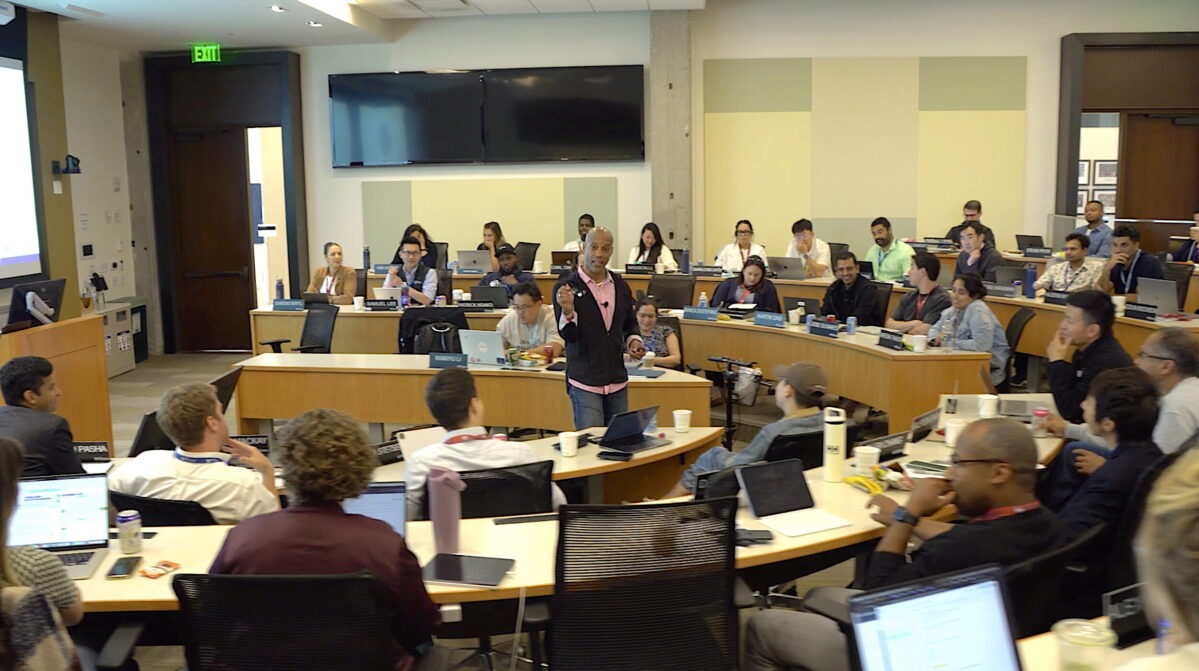
Americus Reed addresses a classroom of students, standing in the center of a semicircle seat arrangement.
Professor of Marketing Americus Reed engages EMBA and MBA students for his Block Week course, Sales 3.0 and the Future of Revenue Growth. (Image Credit: Jeremy Francis)

Courses take place in Philadelphia, San Francisco, and global locations (including Seattle, Seoul, and Paris). Led by Wharton’s world-class faculty, Block Weeks include hands-on projects, site visits, and guest speakers connected directly to the course theme.

These concentrated sessions create a unique environment where experienced professionals and full-time students challenge one another, compare perspectives, and build networks extending far beyond the classroom.
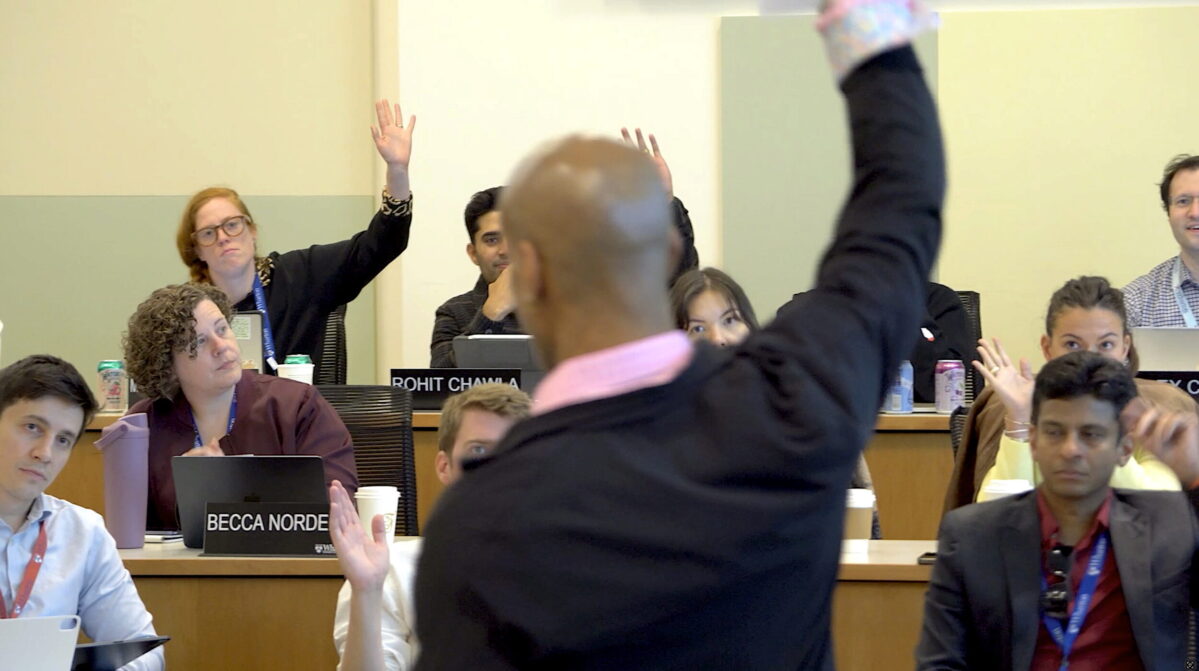
American Reed stands with a raised hand before seated students, many of whom also have raised hands.
A Block Week course is just one of a number of concentrated, exploratory learning opportunities available for students across the Wharton School. (Image Credit: Jeremy Francis)


Integrative Education: The Wharton Way

Across all levels, the thread connecting Wharton’s exploratory learning opportunities is the School’s commitment to integrated, real-world education.

“When you have to take on a challenge in three dimensions, you don’t just pull information from one class or one framework,” says Vice Dean Lamberton. “At Wharton, what matters most is integration across different domains of learning — and the ability to apply things that students are learning in the real world in ways that often push the boundaries of theory.”

“Our classes aren’t the finish line — they’re the launch pad. We want to create more immersive experiences for students when they take on these challenges,” Lamberton adds.

The breadth of exploratory, global, and concentrated learning opportunities across Wharton reflects a philosophy that meaningful education happens when students engage deeply, think critically, test ideas, and encounter the real world with curiosity and interdisciplinary thinking. This is what uniquely defines a Wharton business education — one without boundaries and limitations.

Posted: January 26, 2026
Wharton Stories

Dancing Students Toward Health Care Career Opportunities

Image: One of the experiential events in a course teaching health care leadership was a dance contest among teams of Wharton undergraduates and West Philadelphia high school students. (Image Credit: Hoag Levins)
“For a class to be memorable, it has to have emotional resonance, which can come from joy, shared struggle, or deep connection,” says Dr. Marissa King, an LDI senior fellow and Wharton School professor of health care management. “There is a science to creating connection, and that is what we do in this course.”

How do dance contests and paper airplane races relate to effectively teaching a health care leadership course at the Wharton School? That question quickly comes to mind upon entering the classroom of Dr. Marissa King as she presides over what can feel like an academic mosh pit: nearly five dozen students in constant motion — dancing, flailing, and shouting encouragement at their chosen teams while the Village People’s “Y.M.C.A.” thunders through the room, loud enough to shake the tables.

“My goal is impact,” explained King, a Leonard Davis Institute of Health Economics (LDI) senior fellow and Wharton School professor of health care management. “As students enter medical school, nursing school, and other health care career paths, they often get bogged down in the technical side of medicine. I want them to remember — and live — the importance of social connection.”

To read more, click here.

By Hoag Levins

Posted: January 23, 2026

Wharton Stories

How Wharton Helped This Marine Accelerate His Career

Image: Neal Ellsworth, WG'24, with EMBA students in Prof. Kevin Kaiser’s Valuation course. (Image Credit: Kevin Kaiser)
“The Career Management team was there for every stage: job search strategy, resume, interviews, negotiations – everything. And my executive coach helped me think holistically about what I wanted,” says Neal Ellsworth, WG’24.

When Neal Ellsworth, WG’24, thinks about his career path, he says that it’s never followed a traditional trajectory. After graduating from Michigan State University with a business degree, he wasn’t drawn to corporate life. Instead, he wanted something that would test him physically, intellectually, and globally. That turned out to be the U.S. Marine Corps.

Neal Ellsworth with his MARSOC team. (Image Credit: MARSOC)

As an infantry officer, Neal deployed to Australia where he first learned about special operations missions. Soon after, he became a Special Operations Officer with the U.S. Marine Corps Forces Special Operations Command (MARSOC), completing multiple overseas deployments. Graduate school, he thought, wasn’t in the cards.

But after returning from deployment, a fellow veteran changed his perspective. “He advised that an MBA from a top-tier program could help me transition to the private sector,” Neal notes. 

That encouragement sparked a new chapter. Conversations with veterans several years ahead of him helped Neal see graduate business education as not just possible, but potentially transformational. And when he began exploring programs, Wharton rose to the top.

“The veterans community at Wharton welcomed me even before I applied,” he explains. “They shared their experiences, helped me understand the process, and made me feel like I already belonged. That sense of community was a huge factor.”

Neal was accepted into Wharton’s full-time MBA program in 2020, but his career took an unexpected turn when he was selected to serve as a liaison to the House Armed Services Committee, an opportunity he couldn’t pass up. While working on Capitol Hill, he learned about Wharton’s MBA Program for Executives and realized it was the perfect fit.

“A friend encouraged me to consider the Executive MBA because I had a decade of experience, and I’d be learning alongside other mid-career professionals,” he explains. “It felt like the right move.”

Neal began Wharton’s EMBA program while still on active duty, finishing his final months on the Hill. After leaving the military, he joined Vannevar Labs, a venture-backed defense technology startup.

He recalls, “It was an amazing experience getting real-time exposure to a high-growth company while learning the business frameworks behind everything we were doing.”

Strategic Career Advising at Every Step

As Neal began exploring long-term career options, he turned to Wharton’s EMBA Career Management team for guidance.

“They were there for every stage: job search strategy, resume, interviews, negotiations — everything,” he says. “And my executive coach helped me think holistically about what I wanted.”

The career team helped him build a detailed spreadsheet to assess roles, industries, and compensation, an exercise that proved especially valuable for someone transitioning from the military, where salary structures are public and standardized.

Neal Ellsworth with his daughter at graduation. (Image Credit: Allyson Ellsworth)

“In the military, there’s no negotiating your pay,” explains Neal. “Having to assess my market value was completely new. They helped me understand not only what I was worth today, but how to think about the long-term trajectory of each opportunity.”

That preparation paid off. As he transitioned from the military, Neal was fielding three strong offers — each with different strengths. With the help of Wharton’s career team, he negotiated confidently and ultimately chose defense tech.

Lifelong Support for Alumni

Neal spent several transformative years at Vannevar Labs as a business unit leader, helping the company scale from 40 to 280 employees. He built one of the company’s business units from the ground up, an experience he describes as “an MBA in action every single day.”

Recently, Neal was ready to explore a new challenge. This time, he approached the job search with more precision, leveraging the frameworks and tools developed during his time at Wharton.

Neal also turned to Wharton’s Career Management team, which offers alumni lifelong support. “I met with my Wharton executive career coach regularly,” he says. “In the end, I received four offers; having that amount of choice is amazing. I’m so grateful that this level of career coaching continues for alumni.”

Leveraging the Full Power of Wharton Resources

So, what exactly did Neal utilize as a Wharton student and alumnus to accelerate his career?

He breaks it down:

One-on-one Executive Coaching
“Consistent sessions helped me refine my goals, prepare for interviews, and negotiate offers with confidence.”

Career Data and Frameworks
“The tools provided, particularly the compensation and role-mapping spreadsheet, still guide my decisions today.”

The EMBA Job Board
“The EMBA job board focuses on mid-career roles, not just entry-level MBA positions. And because I was in the EMBA program, employers treated me as a highly experienced full-time professional making a transition — rather than a student.”

The Wharton Network
“From defense-tech leaders to classmates in gaming, media, tech, and energy, I used Wharton’s network to explore industries I had never considered before. The willingness of people to talk with me was incredible.”

Neal Ellsworth with his Learning Team on the Philadelphia campus. (Image Credit: Anastasia Forte)

Classmates

“The diversity of experience in Wharton’s EMBA program was eye-opening. In the military, career paths are linear. At Wharton, I realized you can take your career in so many directions.”

A Transformational Experience

“Wharton changed the trajectory of my career,” says Neal. “The classes, especially Prof. Kevin Kaiser’s Valuation, shaped how I think about value creation, strategy, and opportunity cost. I use those lessons every day, for both business decisions and personal career decisions.”

When asked what advice he would give current or prospective EMBA students, Neal keeps it simple: “Jump in and use the resources. Even if you’re not planning a transition now, you will eventually. Wharton gives you the tools, but you have to use them.”

By Meghan Laska

Posted: January 19, 2026

Wharton Stories

How the Wharton AI & Analytics Accelerator Helped Penn Vet Turn Data Into Action

Image: Kyle Kearns
“It was really powerful for our leadership to see that we brought a real problem to the students, and they came back with something tangible,” said Sarah Trout, associate director of Penn Vet Advancement Services.

When Penn Vet joined the Wharton AI & Analytics Accelerator, the goal was clear but ambitious: make better use of years of client and hospital data to strengthen engagement, fundraising, and long-term strategy. For Chase Engel, assistant director of Annual Giving, and Sarah Trout, associate director of Penn Vet Advancement Services, the Accelerator offered a rare opportunity to step back from day-to-day operations and ask deeper, data-driven questions about how Penn Vet connects with its community.

“We’ve always known we have a lot of data,” Trout said. “But we didn’t have the tools or resources to really analyze it in a way that could change how we work.”

Through the Accelerator, an experiential learning program run by the Wharton AI & Analytics Initiative (WAIAI), Penn Vet partnered with a multidisciplinary team of Wharton and Penn students who worked directly with the organization’s real-world data and business challenges.

To read more, click here.

By the Wharton AI & Analytics Initiative

Posted: January 16, 2026

Wharton Stories

How Wharton Is Helping This Heart Surgeon Expand Her Impact Beyond the Operating Room

Image: Dr. Sarah Minasyan, MD, WG’23 and classmates reuniting for an educational session on AI in healthcare (Image Credit: Karl Power)
“I now understand how hospitals run from a business perspective. I can speak the language. That changes everything,” says Dr. Sarah Minasyan, MD, WG’23.

Why would a successful cardiothoracic surgeon get her MBA at Wharton? For Dr. Sarah Minasyan, MD, WG’23, the answer traces back to a Russian saying she grew up with: “Live 100 years, learn 100 years.”

Her path to Wharton — and to the operating room — was shaped long before medical school. Raised in the former Soviet Union, she experienced political and personal upheaval in her teenage years. After the fall of the Iron Curtain, the country she had been taught to trust began to crumble. During that same period, she lost her father to brain cancer.

Her mother, recognizing both the shifting political landscape and the need for a different future, made the life-altering decision to leave. It took six years and a complex web of bribes, but they finally received permission to emigrate. “When we left, we had almost nothing,” Sarah recalls. “My parents were scientists, and the most expensive things in our home were books.”

In the U.S., she accelerated quickly, learning English, graduating valedictorian, and earning her undergraduate degree from UCLA. Her interest in medicine stemmed from both practicality and inspiration. 

“Living in Russia, I saw how the world can quickly change,” she says. “But the human body does not change. If I ever needed to start over in another country, I could continue practicing medicine because it is universal.”

As for inspiration, a family friend who was a renowned congenital cardiac surgeon “walked on water” in the eyes of her community. Watching a highly respected master surgeon at work sealed her career choice of cardiothoracic surgery.

Recognizing a Knowledge Gap

For years, Sarah thrived in high-stakes surgical environments. But over time, she observed a growing challenge. Physicians and

Dr. Sarah Minasyan with UC Davis cardiac surgery residents. (Image Credit: Angelica Martin, MD)
Dr. Sarah Minasyan, MD, WG’23, with UC Davis cardiac surgery residents. (Image Credit: Angelica Martin, MD)

administrators, she realized, often spoke two different languages. “Hospital administration spoke business, and I didn’t understand that language,” she says. “Yet as a surgeon, you work within complex systems. You have to engage with the business side whether you intend to or not.”

When the COVID-19 pandemic hit, the mother of four saw both a crisis and an opportunity. “I realized this was the time to learn the language of business,” she says. “And if I was going to do it, I wanted to learn from the best.”

Her husband, also a surgeon, helped her research programs. When they saw that Wharton offers a San Francisco cohort, the decision was made. She applied only to Wharton. “It was an investment in myself. Go big or go home.”

Stretching to Meet a New Challenge

Sarah entered Wharton with an MD and years of surgical leadership, but she describes her early coursework with humility: “Many of my classmates were engineers or deeply immersed in the business world. I had so much catching up to do.”

Her classmates quickly became a source of support, especially during weeks when she was juggling major surgeries and exams. “I’ve operated in teams my whole career, but this was a new kind of team. It was phenomenal,” notes Sarah.

Sarah also came to appreciate how her clinical background offered unique value. She explains, “Surgeons make critical decisions with limited information every day. That translates directly into business leadership. I didn’t realize how relevant that instinct was until Wharton.”

Global Perspective and Applied Impact

Although COVID canceled her planned Global Business Week in Sweden, Sarah refused to let the opportunity disappear.

Dr. Sarah Minasyan, MD, WG’23 at graduation with her husband
Dr. Sarah Minasyan, MD, WG’23, at graduation with her husband Jason Marengo, MD. (Image Credit: Wharton MBA for Executives)

Instead, she designed her own independent study and traveled there anyway, with Prof. Guy David (Alan B. Miller Professor; Chair, Health Care Management Department) advising her project. She used the Wharton network to connect with Swedish health leaders and investigate why Sweden’s heart failure readmission rates in rural areas are dramatically lower than those in the U.S.

Her findings were illuminating: remote monitoring, telehealth, and mail-in labs formed the backbone of Sweden’s success. “The prototype is there,” she notes. “Adopting similar models in the U.S. would require policy changes, but it’s possible — and it would save lives and reduce costs.”

Following graduation, Sarah was recruited by Utkars Jain, WG’25, to the clinical advisory board of HEARTio, an AI startup aiming to address one of the biggest bottlenecks in emergency medicine: rapid triage of chest-pain patients. “If you can accurately triage patients early, you free up beds, reduce costs, and improve outcomes. It aligns perfectly with my expertise and Wharton’s emphasis on operational impact,” she says.

The Value of a Wharton MBA

For Sarah, the value of the Wharton MBA is about opening new worlds:

  • Career relevance: “I now understand how hospitals run from a business perspective. I can speak the language. That changes everything.”
  • Expanded networks: “You open a new world for yourself from CEOs and innovators to policymakers. The Wharton brand opens doors.”
  • Family benefit: She often jokes that the degree is also an investment in the next generation because the network benefits her kids as well as her classmates’ children.
  • Personal growth: “You keep on learning. You stay curious. That matters.”

“Consider it an investment in yourself and in your future influence,” she says. “If you want to lead, if you want a seat at the table, you need the knowledge and confidence to speak the language of business. Wharton gives you that and more.”

By Meghan Laska

Posted: January 5, 2026

Wharton Stories

New Vice Dean on Fearless Students and Undergrad Business Education

Image: Vice Dean Lamberton chats with Wharton peer advisors on Locust Walk. (Image Credit: Jackson Eli Ford, W’27)
Marketing Professor Cait Lamberton discusses becoming Vice Dean of the Wharton Undergraduate Division.

Talking to Vice Dean Cait Lamberton in her office in Steinberg Hall-Dietrich Hall, it’s tempting to think of her as a permanent fixture of Wharton life. With a deft feel for the pulse of the undergraduate student body, it’s easy to imagine that she’s been here since the days of Joseph Wharton himself.

It’s harder to imagine that the vice dean’s first job was as a quality control clerk for a truck mirror factory, or that she spent her undergraduate years studying not business, but English.

The journey might appear mystifying but, after conversing with her, the metamorphosis seems almost inevitable. I found the vice dean incredibly energizing, with a deep sense of curiosity that has clearly dominated her work as an educator, researcher, and now administrator.

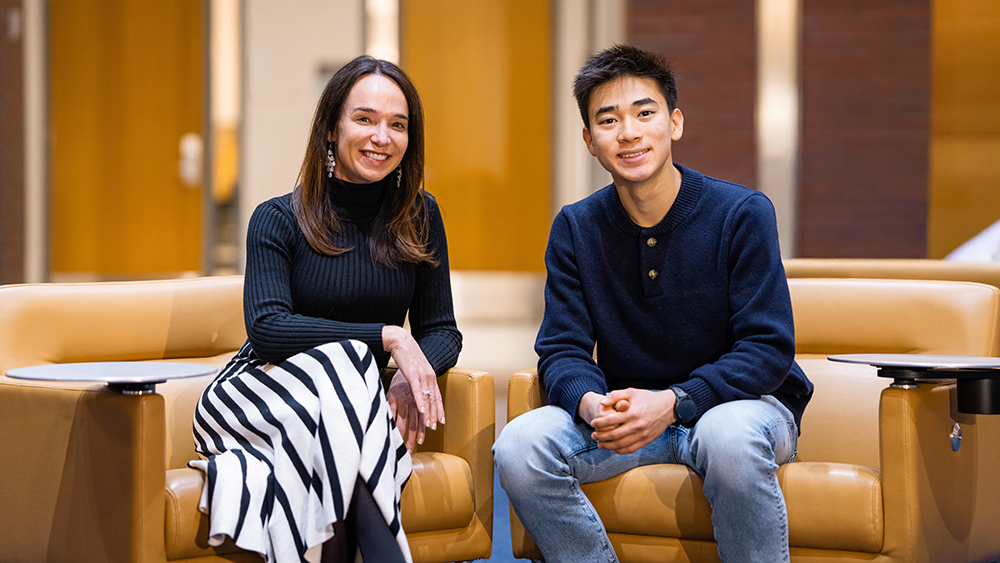
Two people sitting in tan chairs, smiling toward the camera in a bright indoor setting.
Cait Lamberton and Alan Li, W’28 (Image Credit: Jackson Eli Ford, W’27)

What made you want to take on this role? 

A few years ago, I had a conversation with Deputy Dean Nancy Rothbard, and she asked, “Where do you want to go?” I realized I didn’t have a great answer, but I knew that I found the undergraduates energizing and exciting. At the same time, I knew that I didn’t want my entire job to be teaching, as wonderful as that is. I like dealing with new challenges and learning new things, and I knew I’d look for that moving forward.

Being vice dean was not on my bingo card. But when the opportunity came, I thought, that’s a new kind of challenge. There comes a time when you feel like you become very specialized in a narrow area. It’s great because you can access that part of your brain all the time. But I knew this would make me activate a whole different set of pieces in my brain.

What does your role look like day to day?

It’s different every day, which is what I love, right? I mean, I don’t like things to be the same every day. I’d lose my mind.

How would you describe Wharton’s students? 

You can’t generalize about everybody, but many of them are quite fearless. They will share their ideas with you; they will try things they’ve never tried before. When I was younger, if I’d had a grand ambition, I’d have been afraid to state it. I don’t see that among Wharton undergraduates at all. 

If you could change anything about the Wharton undergrad culture, what would you do? 

There are times when — and this is true not only for Wharton students, but for Wharton as a whole — I think we could laugh more. 

We could enjoy our success a little bit more — allow the success that we’ve had to make us feel more comfortable when things don’t go as expected.

When students have ideas or concerns, how do they reach you? 

Image Credit: Jackson Eli Ford, W’27

In the spring, because I won’t be teaching, I’ll have a lot more time for office hours, and I’ll set up a bunch of lunches that students can sign up for. 

My email address is also not hard to find, but the email inflow is so large, it might take me a minute to get back to people. 

What I’m learning is that I often don’t personally have the answer, but I can find other people who do. And that’s a fun process. A few days ago, I had a student in class who asked, “I’m really trying to figure out whether I’d want to start my career in discipline X or whether that’s going to pigeonhole me.” It was a little puzzle for me: who can you talk to who can give him some advice? 

Why would you recommend an undergraduate business education? 

An undergraduate business school teaches students generalizable models, frameworks, and techniques that allow them to look at the problems that society faces and connect them to the solutions being created.

This is a very specific experience: taking what you learn in the classroom and applying it. We’ve said for a long time that 50 percent of the learning in a Wharton education is in the classroom — and it’s true. 

It’s like learning a language. It’s easy to learn in a classroom, but you show you’re fluent when you can navigate a complex situation. That’s what an undergraduate business school education is about. 

Why do you consider Wharton to be one of the best business schools in the world?

Wharton has remained very true to its roots. It was the first undergraduate business school in the world — being first means you get to set the standard. And our faculty are encouraged to do consulting, own businesses, and be part of the world. The fact that Wharton encourages faculty to participate in the market and then bring that back into the classroom is part of what makes our classes quite remarkable.  

We are also one of only two Ivy League universities with an undergraduate business program. Being part of this incredible university gives us access to a broader set of conversations. We have dual-degree programs that enrich our population a great deal, and we have access to a host of centers and resources like Venture Lab, which might not exist at a school without the broader umbrella that Penn offers. 

I’ve also come to realize the power of our alumni network. They want to engage with students, and there are plenty of different resources they can offer, but they are particularly generous with their time. I’ve never seen anything like it. 

I will literally meet people on the street who tell me they went to Wharton, and they’ll stop and say, “What can I do? How can I help? Can I talk to your students?” That’s pretty amazing. You can say, “That’s just Wharton being Wharton,” but it’s different from any other place that I’ve been. I couldn’t be more honored to be here.

— Alan Li, W’28

Posted:

Wharton Stories

Monumental Sculpture Gifted by Wharton Alumnus

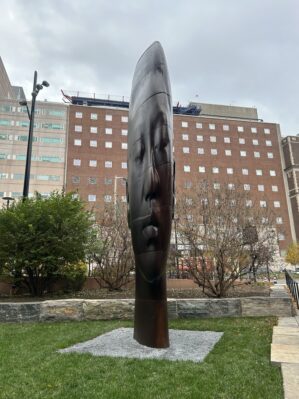
Image: Penn President J. Larry Jameson, donor Glenn Fuhrman W'87, WG'88, artist Jaume Plensa, and Ava Cappitelli at the dedication of "Rui Rui." (Image Credit: Eddy Marenco)
A generous gift from Wharton alumnus Glenn Fuhrman, W’87, WG’88, and his wife Amanda Fuhrman, C’95, brings the sizeable work of internationally acclaimed artist Jaume Plensa to Penn’s campus.

The University of Pennsylvania installed “Rui Rui” on campus in late 2025, a monumental addition to the Penn Art Collection. At 23 feet tall and 19,608 pounds, the cast-iron bust is a quiet giant whose mirage-like exterior belies its solid construction. The work of Spanish sculptor Jaume Plensa, the massive form is modeled and named after his daughter-in-law and continues the artist’s contemplation of the human head in awe-inspiring scale.

The sculpture is the gift of Wharton alumnus Glenn Fuhrman, W’87, WG’88, and his wife Amanda Fuhrman, C’95, both of whom are philanthropists and long-standing patrons of the arts.

An oversized sculpted bust of a woman's head stands outside the Penn Museum with hospital buildings in background.Image Credit: Brian Kantorek

“Penn is a place for cultural and creative vitality, for anyone who walks onto our campus. The sculptures across our grounds exemplify that ethos: they are for students, for Philadelphia, for all,” said Penn President J. Larry Jameson at the sculpture’s unveiling in Harrison Garden, a leafy oasis adjacent to the Penn Museum and the Clifton Center for Medical Breakthroughs. “We are deeply grateful to Glenn and Amanda for sharing our vision and bringing this inspirational work of art to Penn.

To read more, click here.

Posted: December 26, 2025

Wharton Stories

Between Problem Sets and Possibility: A First-Year’s Reflection

Image: Jaya (far right) and friends at the 2025 Baker Retailing Center Ideathon. (Image Credit: Akshay Kumar, C'29, W'29)
Jaya Parsa, W’29, contemplates her first semester at Wharton.

As a fellow former Florida DECA officer, Jaya Parsa reached out to me in early August of this year, asking for advice as an incoming first-year at Wharton. 

Hearing her voice over the phone, I thought back to my own experiences navigating a variety of life-altering moments those first two semesters, realizing it would be impossible to sum up all the necessary guidance. So I offered the first thought that came to mind: buy a sturdy winter coat. 

Five months later, I’ve seen Jaya successfully dive into Penn. She’s navigated the Appalachian backcountry with Wharton Leadership Ventures, dominated problem sets in a Huntsman Hall computer lab, and successfully toiled through her writing seminar — all with her trademark optimism. 

That isn’t to say that the first semester has been smooth sailing. Like many first-years, adjustment for Jaya has taken time and introspection. Below, Jaya reflects on her first months at Penn and looks forward to the inevitably unpredictable — yet exciting — future.


“The biggest surprise: just how hard it would be to find yourself when you really don’t know what you’re trying to find.”


Tell us about your rose, bud, and thorn (success, growth area, and challenge).

Rose-wise, I feel very lucky to have found some really great people here. I’m involved in some good communities, which I’m excited for. I feel a little bit more at home than I expected. Thorn-wise, I still feel very lost career-wise and in my goal setting. In terms of bud, I’m excited to be busier. Next semester, I want to get involved with more things and be more intentional with my time. 

What are you involved in and why?

Penn Masti's 11 new members pose on College Hall steps
Penn Masti’s new members in fall 2025. (Image Credit: Anoosha Shukla, C’28, W’28)

Currently, I’m on the Masti dance team, and I’m a Wharton Venture Fellow.

I joined Masti because I really wanted that initial sense of community. Dancing was something that I had just done as a kid for fun, but I never seriously thought about pursuing it. But I just loved the energy that I felt from Masti, and the people seemed really great, so I wanted the chance to connect with them on a deeper level. 

Wharton Leadership Ventures was something that was out of my comfort zone, and it intrigued me because of the potential for how much I could learn. I’ve always been interested in leadership, but coexisting with the outdoors is something that I didn’t ever expect myself to get into. 

How do these activities fit into what you hope your first year will be?

Coming to Penn, my main goals were to find interesting people and perspectives. I wanted to meet a lot of characters. I’m from Fort Myers, which is a relatively small town in Florida. It’s totally different from the Northeast and the pre-professional, bougie-ish environment that I see here. 

Where are you now relative to your expectations for your first year?

I still don’t have a set community here. By now, I expected to have totally found my people — which is crazy because it’s only been a couple of months, and this is a whole new facet of my life — but I think I haven’t met my expectations in that sense. 

Biggest surprise so far?

I had the idea that, when I came to Penn, everything was just going to be perfect and would magically work itself out. And that didn’t happen. That was the biggest surprise: just how hard it would be to find yourself when you really don’t know what you’re trying to find.

What’s the biggest thing that’s happened?

Honestly, a combination of all the small things that have made Penn a lot better than I expected. I enjoy just the late-night college yap sessions with my friends, or getting food and having those meaningful conversations. 

What’s on your mind most these days?

I’ve been thinking a lot about what I want next semester, next week, the next day to look like, and how I can actively build to get to where I want to go. I’ve definitely been thinking a lot about what I want to get out of the next four years because the first semester really flew by. 

What do you want to accomplish by the end of the academic year?

I want to have at least three very close friends — hopefully a friend group. I want to work for a startup in the Philly area, make sure that the relationship with my parents is still good and I’m calling them every day, and still hopefully be in touch with my hometown friends. I want a better sense of what I want my long-term goals to be.

When you look back on this interview in the spring, what do you think you’ll feel about it? 

‘Oh, she was just a baby.’ I want to look back and realize that, in the past six months, I’ve totally changed my outlook on what I’ve wanted — and it would be cool to look back and see that I ended up wanting something completely different.

Advice you’d give your future self.

Something that my dad just said to me last week, which really stuck: ‘Don’t be too hard on yourself.’ Whatever happens — no matter how bad you’re objectively doing — if you’re hard on yourself, it just makes it worse, and you get into that negative feedback loop. So next time, when I’m busier, I still want to feel good about it because it’s too short of a time to stress.

— Alan Li, W’28

Posted: December 22, 2025

Wharton Stories

Globalizing Education Through the Tanoto Initiative

Image: Wharton MBA students learned sustainable business practices firsthand during a Global Modular Course (GMC) in Riau, Indonesia. (Image Credit: Wharton Magazine, Courtesy of the Tanoto Initiative)
Supported by Wharton and the philanthropic Tanoto Foundation, the Tanoto Initiative has fostered close ties between the School and Southeast Asian institutions.

As a Wharton alumnus and Tanoto Foundation Board of Trustees member, Anderson Tanoto believes it is essential that we maximize the utility of education to create value, impact, and opportunities. The journey to scaling up includes nurturing global, holistic citizens into future decision-makers and leaders. More than ever, during these challenging times — marked by polarizing and narrowing views — it is imperative that we remain committed to globalizing education and partnering with like-minded institutions and stakeholders.

Read the full Wharton Magazine article here.

By Anderson Tanoto W’11

Posted: December 15, 2025

Wharton Stories

(105) Days of Summer

Image: Anita Vasserman's view during runs with the Unofficial Run Club in Sydney, Australia. (Image Credit: Anita Vasserman W'28)
Three Wharton students reflect on how first-year summers can be a time for growth, utilization, and introspection.

For many Wharton students, their first-year summer can be a welcome respite as well as a time to return to local communities, explore distant foreign lands, or apply skills acquired during the school year. 

There may only be 105 days of summer vacation, but an infinite number of opportunities. Three students show that first-year summers are growth and learning experiences, regardless of whether the role is traditionally “resume-ready.”


As a native of Lake County, Illinois, Darius Anta, C’28, W’28, has always known about the invisible lines dividing the county north of Chicago.

“The southeast side is better off, with access to lots of different organizations that provide substance-abuse treatments,” Darius said. “The majority of the population lives in an access desert.”

To Darius, this summer provided a means to disrupt the status quo.

“It was personally important to me that I spent my first-year summer [giving] back to something that I care about and impacts a lot of people’s lives,” said the dual-degree student in the Huntsman Program in International Studies & Business.

Darius interned at Nicasa Behavioral Health Services, which brings substance-abuse and addiction treatment to Lake County’s underserved areas. At most locations, an immense backlog of clients exists.

As a strategy analyst, Darius worked on that challenge. 

Darius, who uses the pronoun they, recalled Operations, Information & Decisions 1010, where they learned how bottlenecks could cause outsized constraints. This led them to the culprit behind the wait: clinician documentation requirements. 

Darius points out that clinicians spent hours formulating notes to be compatible with various bureaucracies. Working with executives, Darius deployed an AI tool to provide automatically compliant documentation, freeing clinicians to devote more time to clients.

They believe their summer provided the rare opportunity to apply class concepts. 

“In a leaner team, I was able to actually put knowledge into action,” Darius said. “I saw how we could put clients instead of profits at the center of our business and still succeed.”

Two people stand beside a large Nicasa Behavioral Health Services sign outside a brown building
Darius (right) with Vicky Tello, Director of Philanthropy, at Nicasa Behavioral Health Services Clinic in Round Lake, Ill. (Image Credit: Courtesy of Darius Anta)

For Canadian Anita Vasserman, W’28, life in Philadelphia often feels like an upside-down version of her Toronto life, with different yet oddly familiar slang, traditions, and foods. When the opportunity arose to truly go upside down in the Land Down Under with Penn’s Global Research and Internship Program (GRIP), she thought she was ready.  

Before Sydney, Anita assumed she had already seen the two sides of business: the American one (fast-paced and high-stress) and the Canadian one (slower-moving and more people-centric). 

In Australia, she realized business culture is a spectrum. Sydney is more relaxed than Canada, and that took Anita time to adjust. 

“When I had a meeting with my boss at 9:00, that meant she would show up at 9:15, and that was the norm,” Anita said. 

Soon, she found herself preferring the chilled-out Aussie atmosphere, since it helped her build stronger relationships with her colleagues. She felt more genuine and comfortable, engaging with others on a personal rather than professional level. 

Lessons from moving to a second foreign country didn’t end at the office. Living on her own provided time for introspection, and exposure to a new culture helped Anita prioritize her values. 

“There’s so much more beyond careers,” she said. “After you get a job, what comes after the 9-to-5 is just as important.” 

Anita made friends her age through GRIP’s cohort-style experience. She found herself deeply appreciating the Australian concept of “mateship,” a cultural idiom that describes loyalty and unconditional friendship. She took night walks on the shoreline with friends and joined the Unofficial Run Club — 5:30 a.m. runs near the iconic Sydney Opera House. 

“Life becomes so much more fun when you live in the moment rather than always looking ahead to your next preprofessional goal.”

A smiling worker stands behind a bakery counter with pastries, signs, and drink coolers behind her.
Katie behind the register at Gateway Croissants in San Francisco. (Image Credit: Quuyh Nguyen)

For Katie Wu, W’28, summer was the season of dunking: both basketballs into nets and donuts into smooth, sugary glaze. 

Katie returned home to San Francisco, where her family has operated a donut shop for nearly 20 years. Situated in the Tenderloin district, Gateway Croissants serves a diverse clientele, from executives to homeless individuals.

Working there, she became a jack-of-all-trades: staffing the register, frying bacon, polishing the floors, and bussing tables. The most important lessons, however, have been about the world outside. 

Facing dramatic differences among customers inspired Katie to continue working with varied groups of people to improve communities.

“It’s influenced my decision to get an Urban Studies minor,” she said. “Until you see [the wealth disparity] firsthand, it doesn’t really register to you how big the issue is.”

In the afternoon, Katie transferred her people skills to the basketball court by helping her former high school coach run his private training business. Embracing familiar practice routines, the Penn women’s basketball student manager grew more confident and disciplined.

“I trust my Wharton education to prepare me for the technical [knowledge] and networking I’ll have to do for future internships,” she said. “But I really valued the untraditional work experiences I had this past summer because I was able to grow as a person.”

Katie found herself learning how to work with everyone — whether on the court or at Gateway Croissants’ cash register — gaining skills universal to small family businesses or the corporate world. 

“It’s just a great thing about how my life has worked out,” Katie said. “I’ve gained a better sense of the world, instead of just sticking to smaller segments of people.”

— Alan Li, W’28

Posted:

Read More Stories
Back To Top