


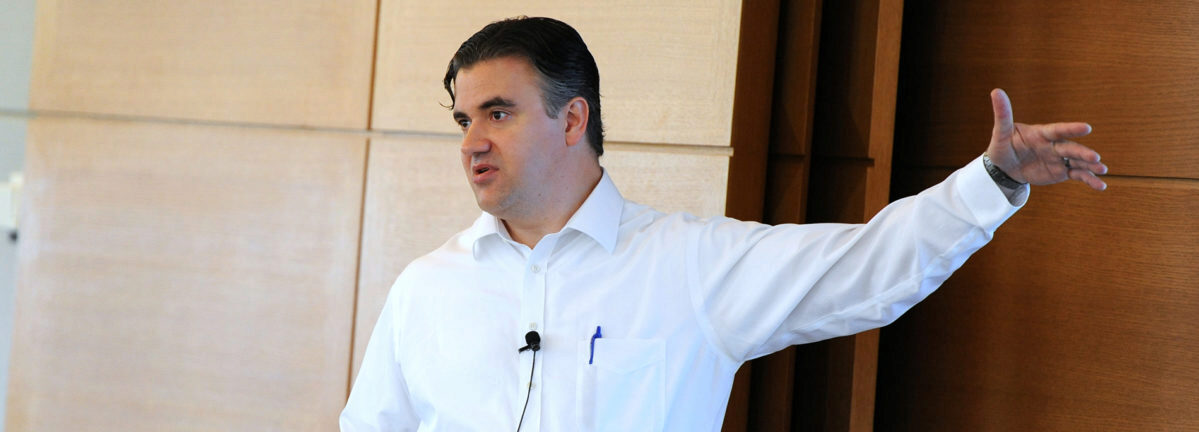
At Wharton, Prof. Kent Smetters, the Boettner Chair Professor, is known among EMBA students for teaching one of the program’s most challenging core courses: Managerial Economics. But as one former student says, “It’s hard in the right ways.”
“My goal isn’t to make the course hard just to be hard,” explains Smetters. “It’s about pushing students to think differently.”
Instead of memorizing formulas, students learn to take a real-world narrative with numbers and data and translate it into an economic model that provides insight. The course teaches them to think through tradeoffs, understand optimization, and apply theory in practical situations.
“That kind of critical thinking is what leaders need in order to make smarter decisions,” he says.
Smetters’ demanding approach reflects his broader philosophy: research and teaching should prepare people not only to understand the world as it is today but also to anticipate how it will change. That perspective comes from a career that bridges academia, public policy, and applied economics.
Engineering a New Kind of Policy Analysis
Smetters grew up in rural Ohio before earning his PhD in economics from Harvard. Rather than immediately pursuing an academic career, he took an unusual path for a new PhD: he went to Washington, DC to work at the Congressional Budget Office. Later, he served as Deputy Assistant Secretary of Economic Policy at the U.S. Treasury during the George W. Bush administration, a period that included the aftermath of 9/11, the Enron collapse, and the drafting of Sarbanes-Oxley.
Those experiences gave him a deep appreciation for how policy is made and what changes are needed. “Agencies are sometimes criticized for being biased, but that’s not the case. The problem is that they are very far behind when it comes to modeling.”
That insight ultimately led to the Penn Wharton Budget Model (PWBM), which Smetters now directs. PWBM is a software-engineering-driven shop that builds sophisticated, scalable models of how policies interact across the economy. Policymakers on both sides of the aisle turn to PWBM for analysis that is rigorous, transparent, and trusted.
“What distinguishes us,” Smetters explains, “is that we’re not chasing headlines. We do deeper analysis, and our models are built so others can understand and build on them. It’s modern economics combined with engineering. That’s why we’re trusted across the political spectrum.”
PWBM also offers a free certificate program, giving participants (including some Wharton EMBA graduates) a deeper understanding of policy modeling and fiscal analysis.
Research With Purpose
Smetters’ academic work continues to push boundaries in applied theory, fiscal policy, and finance. His projects range from modeling the long-term effects of Social Security reforms, to analyzing the effectiveness of minimum wage as a redistribution tool, to studying how tax policies affect venture-capital-backed entrepreneurs.
“This work is very math intensive,” he says, “but the purpose is always to make research useful at scale. It’s about solving problems that once seemed too big to model.”
Smetters’ applied approach has earned recognition, including the TIAA Paul A. Samuelson Award for his research on annuitization.
Beyond the Classroom
While Managerial Economics is the main way EMBA students interact with Smetters, he also supervises independent studies.
One standout independent study project involved a student’s exploration of whether wine could become a financial asset class. Using economic and financial modeling, the student discovered how wine auction dynamics correlated with markets and even identified underpriced vintages.
Other projects have ranged from startup concepts to industry-specific analyses, all grounded in applying classroom concepts to real-world questions.
“My role is to help students take the tools they’ve learned and apply them in creative ways,” he explains. “The best projects start with a question that matters to the student and then build an economic and data-driven approach to finding answers.”
A Message to Prospective Students
For prospective students, Smetters offers a candid perspective on Wharton’s EMBA program: “This is the hardest MBA program in the hardest format. You and your household are making a serious investment, and you need to come in with that mindset.”
But the payoff, he emphasizes, is worth it. “Graduates are incredibly satisfied because they know they’ve been pushed hard to grow,” he says. “We don’t just teach you the tools of your trade today, because those will change. We teach you how to think critically, how to use data effectively, and how to adapt. That way, when your industry shifts — and it will — you’ll have the knowledge and skills required to innovate and lead the way forward.”
By Meghan Laska
Posted: December 1, 2025