



Whether analyzing consumer behavior in Philadelphia, walking factory floors in Stockholm, or debating revenue models alongside Wharton alumni abroad, exploratory learning exists at the heart of a Wharton education across programs and degrees. It is a chance for students to go beyond the conventional classroom setting and into real-world environments where business theory meets practice. These experiences, in turn, help students expand their thinking and test what they learn.
“Anybody can get on a plane and go somewhere,” says Cait Lamberton, vice dean and director of the Wharton Undergraduate Division. “But we want the Wharton experience to be more multidimensional and more integrated with the rest of a student’s education.”
At every level, Wharton’s scope of learning opportunities are designed to meet that vision — giving students the flexibility, global access, and practical education they need to navigate a rapidly changing world. Block Weeks and Global Modular Courses (GMCs) are particularly familiar to students in the full-time MBA and MBA Program for Executives (EMBA), although the Undergraduate Program similarly hosts a range of options to suit students’ busy schedules and unique needs.
Exploratory Learning for Wharton Undergraduates
Wharton offers exploratory options through its Undergraduate Program, combining concentrated study with travel and real-world application. These flexible opportunities provide students the freedom to explore industry practice, engage with Wharton’s global network, and build a sense of community with their peers.
“The truth is that many schools have travel classes,” notes Lamberton. “But, because Wharton has such an incredible alumni network, we often have connections at companies that are excited about partnering with us to create a more robust experience for our students.”
Beyond select GMCs open to Wharton undergraduates in their third and fourth years of study, undergraduates have plenty of other options:
The majority of these qualify as Wharton School-wide global immersion opportunities, offering rich, travel-based learning open to both undergraduate and graduate students.
Modular Courses at Wharton
Modular courses add another dimension to exploratory learning. These 3- or 4-day intensive experiences, worth 0.5 course units, offer flexibility and focus to students at various levels. Modular courses can fulfill credit requirements while customizing a student’s academic path and broadening global perspective.
Wharton offers two modular formats:
Global Modular Courses (GMCs), open to both undergraduate and graduate students
Block Weeks, exclusive to full-time MBA and EMBA students
According to Richard Paul Waterman, practice professor of statistics and data science and EMBA’s deputy vice dean for academic affairs, these approaches encourage invaluable interaction: “It’s a great platform for cross-pollination between Executive MBA and full-time MBA students. [Students] spend time together, collaborate, and learn from one another. That kind of interaction deepens the network you build at Wharton.”
Global Modular Courses (GMCs) Take Wharton Everywhere
GMCs bring students directly into the business realities of regions undergoing rapid change. Over 3-4 immersive days — typically scheduled during academic breaks — students blend faculty-led coursework with site visits, conversations with local leaders, interaction with Wharton alumni and students from host institutions, and exposure to emerging business and social issues.
“GMCs operate at the forefront of innovation in business education, exploring emerging business models, evolving mindsets, disruptions, and innovations,” explains Ziv Katalan, managing director for Wharton Global Initiatives. “They represent Wharton’s ‘laboratory’ for understanding the future of management education.”
During a GMC in the United Arab Emirates (UAE), Wharton undergraduate Fatima Figueroa, W’24, found herself examining how emerging economies take shape by hearing directly from leaders on the ground. “This course deeply enhanced my understanding,” she reflected. “I learned about emerging economies like the UAE and how they seize opportunities, attract talent, and differentiate themselves.” Experiences like this — combining local immersion, faculty expertise, and firsthand perspectives — illustrate exactly how GMCs turn theory into lived learning.
GMC participation at Wharton includes the following:
- Open enrollment for EMBA, full-time MBA, and third- and fourth-year undergraduate students.
- Completion of one or two courses on average, with some students taking up to five or six.
- Two additional required GMCs for the EMBA Global cohort, which are optional for Philadelphia and San Francisco cohort students.
- Courses offered in multiple countries each year, connecting students to live cases and local expertise to bring academic concepts into sharp focus.
- A required Global Business Week (GBW) for second-year EMBA students.
Learn more about the GBW experience and additional options for international study, including the full scope of GMCs.
Block Weeks: Concentrated Learning for Busy Students
Block Weeks are immersive 3- to 4-day courses blending rigorous academic work with real-world relevance, and covering traditional business foundations for emerging trends. Designed exclusively for EMBA and full-time MBA students, they feature experiential learning, deeper cross-cohort collaboration, site visits, and guest speakers — all with flexible scheduling and opportunities to accelerate graduation. Wharton syncs EMBA and full-time MBA calendars for Block Weeks to focus on a total of four individual weeks peppered throughout the year.
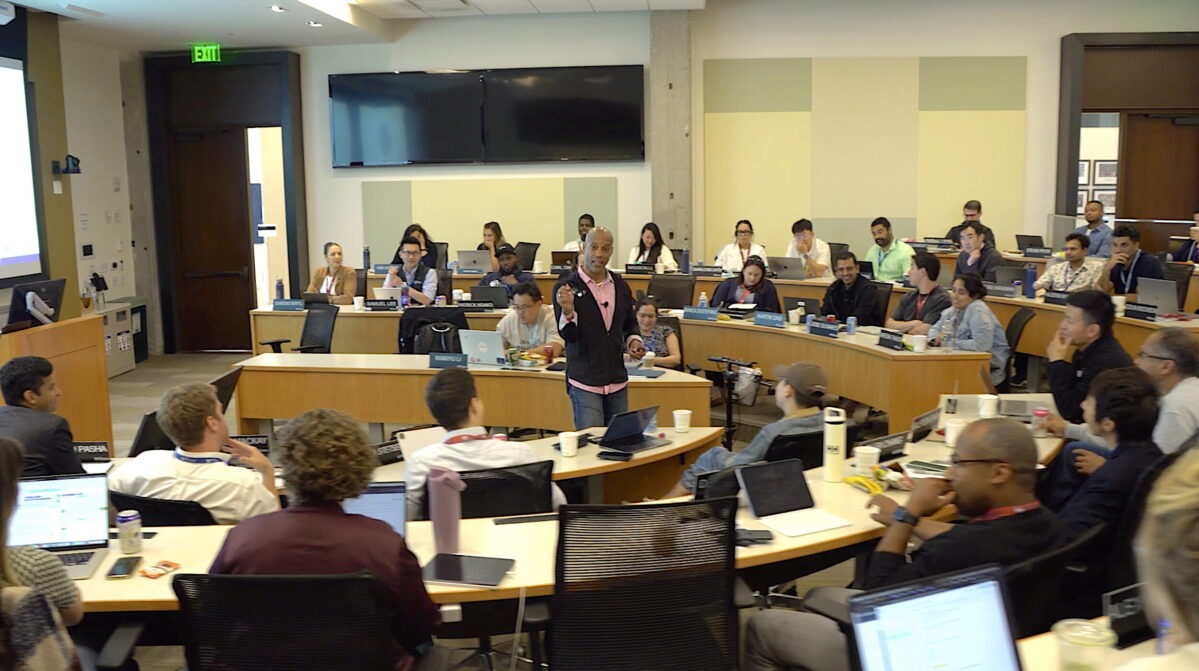
- Professor of Marketing Americus Reed engages EMBA and MBA students for his Block Week course, Sales 3.0 and the Future of Revenue Growth. (Image Credit: Jeremy Francis)
Courses take place in Philadelphia, San Francisco, and global locations (including Seattle, Seoul, and Paris). Led by Wharton’s world-class faculty, Block Weeks include hands-on projects, site visits, and guest speakers connected directly to the course theme.
These concentrated sessions create a unique environment where experienced professionals and full-time students challenge one another, compare perspectives, and build networks extending far beyond the classroom.
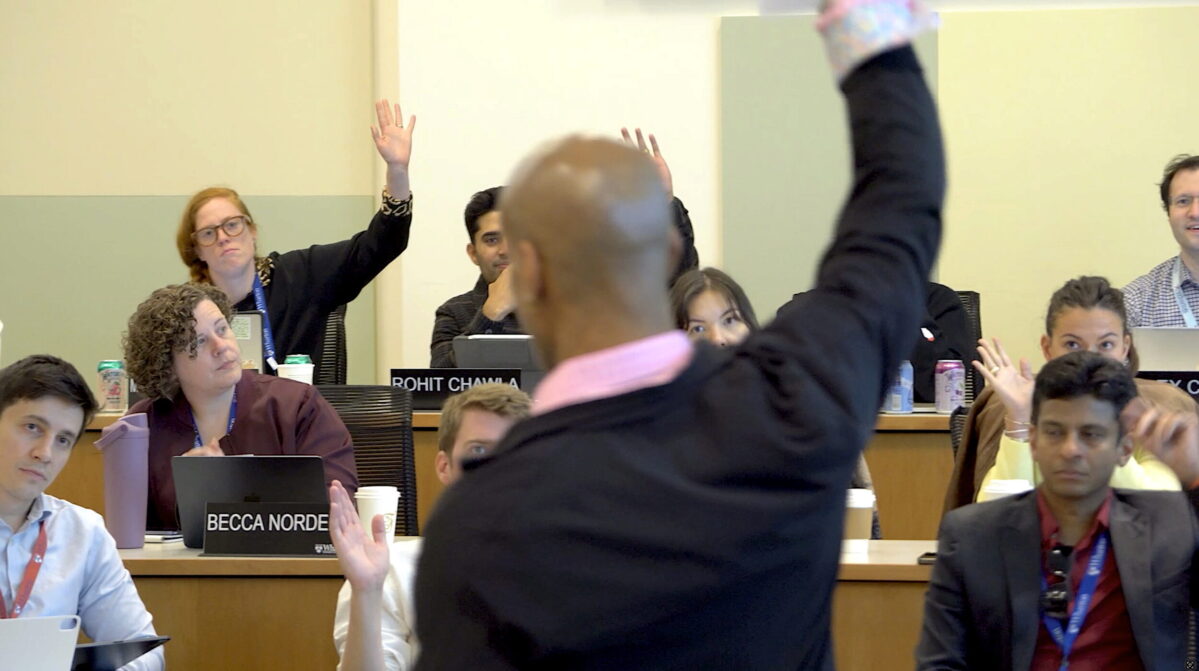
- A Block Week course is just one of a number of concentrated, exploratory learning opportunities available for students across the Wharton School. (Image Credit: Jeremy Francis)
Integrative Education: The Wharton Way
Across all levels, the thread connecting Wharton’s exploratory learning opportunities is the School’s commitment to integrated, real-world education.
“When you have to take on a challenge in three dimensions, you don’t just pull information from one class or one framework,” says Vice Dean Lamberton. “At Wharton, what matters most is integration across different domains of learning — and the ability to apply things that students are learning in the real world in ways that often push the boundaries of theory.”
“Our classes aren’t the finish line — they’re the launch pad. We want to create more immersive experiences for students when they take on these challenges,” Lamberton adds.
The breadth of exploratory, global, and concentrated learning opportunities across Wharton reflects a philosophy that meaningful education happens when students engage deeply, think critically, test ideas, and encounter the real world with curiosity and interdisciplinary thinking. This is what uniquely defines a Wharton business education — one without boundaries and limitations.
Posted: January 26, 2026